The Lakota way is a book that is based around valued principles. I focused on the chapter about respect. Not only becuase it was assigned to me, I feel like respect is one of the most important values to understand and have for everyone.
In this chapter they focus on the deer woman, a beautiful woman with long, black hair down to her knees. Ultimately she can be compared to a siren, men would be attracted to her and spend the night with her, but they would forget about their families and loves of their lives and never want to return. She only shows herself to the lone hunter. One night she comes across Kokalaka, an experienced hunter, and tries to lure him in. He is tempted, but while growing up his grandma had told him about the deer woman, and although she was very persuasive out of the respect of his grandmother he did what he was always told. He refrained from going with her and she turned into and angry deer and he shot her with an arrow and she was never seen again by him. If he had disrespected his grandmother's wishes he would of fallen into the siren's trap.
There are a couple of other scenarios in this chapter that come into play and all focus on respect, like not killing innocent animals for fun, but out of neccessity. Respect helps keep the world in check.
Not being a very emotional person I found it extremely hard to try and connect with Patricia Grant speak about the Cherokee Forgiveness. She is a member of the
Eastern Band of Cherokee Indians. She explained to us the troubles
her people endeavored, her meanings of trauma, and the sacred hoop of
balance. Trauma, to her, is cumulative, and psychic wounding across
generations was related to the massive root trauma. This trauma was
a direct result form the Trail of Tears. Where 17,000 Indians were
removed from their homes and forced to march through the winter
months with almost no sleep in attempts to try and exterminate them.
Indians owned almost all of America and after a period of 500 years
it dwindled to a mere 50,000 square acres.
I knew it was hard for her to stand up there and talk about what she has dealt with and the horrific events that occured, but I was unable to fully understand the pain she felt since I am not a compassionate person.
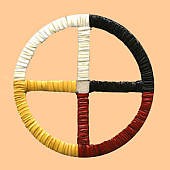
Sacred Hoop
Throughout her presentation
she compared Indians to Americans. Indians work in a circular
fashion while Americans work in a linear way. The sacred hoop
emphasizes balance, harmony, the whole, and spiritual being. They
have different morals and way of living that we do not. The first
thing she said was that WE did this to her people and at first I took
it personally because it was not I who did this and she seemed as
though she was holding a grudge. Afterwards, I decided that it was
not us she was mad at. It was our ancestors and there is nothing we
can do to change the past, but it is still hard to deal with the
trauma that emerged from this event.
The journey to forgiveness is an effort to help enlighten people about the tragic events suchs as the Trail of Tears and hopefully make people realize the amount of trauma that has been passed through the generations as an effect to these events. More information about the journey is provided through the link below and there is a video on the site :) Enjoyyyyy! Journey to Forgiveness and Healing
The other day in class we were confronted with the question of what we have learned so far throughout the course. Off the top of my head I went blank, had I learned nothing so far? It took a couple minutes to start piecing things together throughout the course. The course requires me to think further into the blatant and more into the undefined. Reflecting upon the material studied made me realize how much I had truely learned about the Native American culture and life in general.
First of all I realized that prejudiced is still happening everywhere. I never thought of how often it occured because it is not as blatantly stated as it used to be, but it is still there. I also never realized the extent to which it could affect a person. How much of our past do we let define and effect our future. A began to realize these thoughts when learning about Sherman Alexie. He would display his feelings and troubles through his writings and his fellow people did not understand why he would display his awaful past. He was filled with hurt and pain but allowed himself to reveal these thoughts through his works which made them easier to deal with and keep going in life. He stood up to his past and did not allow it to affect him too much.
People would also use Trickster tales to seperate themselves from a traumatic past. The tales would be a way of displaying their feelings, but in a way that would make them humorous and easier to deal with. Coyote would deal with bad event but the story would be twisted to make it funny and resonate with the pain easier. People still do that to this day. Laughter is the best medicine.
Even after dealing with it though how do you confront these troubles? You separate yourself away from the hurt and pain, do you forget it completely or confront the pain and make it be known that your ok with it and that you have learned from it?
While reading The World Turned Upside Down I read a section and it had to do with John Smith. Naturally, while reading I started to doze off and think back to watching Pocahontas and remembering her relationship with John Smith. While going off on this tangent in my head I began to wonder how historically accurate can this Disney movie truely be? So, I decided to use the wonderful world of Google to do some research.
FromTo
Matoaka, or more known as Pocahontas, was the daughter of Powhatan, the ruler of the land called Virginia. To change history into a kid's cartoon is a hard thing to master and along the way some things must be sacrificed. Disney had to eliminate all of the "bad" things that John Smith did in order to more concisely state the love story that occured between Pocahontas and John Smith. In the Disney cartoon John Smith and Pocahontas met in the woods and immeadiately fell in love. In reality, they met when Pocahontas rescued him from his execution. The movie also showed that John Smith was captured one night when he went to sneak out to see Pocahontas. The true story is that he was captured when him and his Indian guide split up during one of their expeditions. Then the Powhatan adopted him as their son where he was widely accepted in the tribe. In reality John Smith went back home to England so she got engaged to Kocoum and she actually married John Rolfe instead.
Although Disney created a great love story, the story was fairly accurate. It had most of the love between John Smith and Pocahontas accurately represented but, unfortunately you could not use the movie for educational purposes. I would of loved to watch this movie for funsies :)
"The Business of Fancydancing" provided me with a new insight about the American Indian culture. Overall, the movie was not one of my favorites. The movie was very choppy and presented the facts in a fashion that I did not find interesting to follow. The movie would be in the present time then flip to a flashback very often, then ocassionally switch to a moment of dancing and chanting. Although it presented moments of heartfelt moments that touched the heart, I am not a super emotional person so the movie did not keep my attention. I also found the movie to be very provacative, the language and open sexuality of the movie made me feel uncomfortable.
The movie was about Seymour, the main character, conflict between his heritage and his life with his white boyfriend. The movie begins as Seymour returns to the reservation for the funeral of his friend Mouse. His friends from the reservation begin to question his motivations for writing his poems and making them public.They say that their culture should not be open to the public.
Since the beginning of this class we have discussed the many unfortunate things that the Native American Indians have been through. Completely uneducated about most of these events I decided to look further into something I have heard about and become more educated upon the subject- The Trail of Tears.
The Trail of Tears by Robert Lindneux
The Trail of Tears is a name given to the forced relocation and movement of Native American nations from southeastern parts of the United States following the Indian Removal Act of 1830. They faced hunger,disease and exhaustion. This journey resulted in a loss of over 4,000 of the 15,000 Cherokees. Jefferson hoped to create a dependancy upon trade with white Americans, therefore thinking they would leave the lands in exchange for goods. Although just just giving a very brief overview of of the Trail of Tears, the manipulation of these people for American selfishness is completely outrageous. To help realize what these people went through I found a poem that explains, in detail, the amount of pain and suffering that was encountered during this event.
The Trail of Tears
I look to the long road behind
My heart is heavy with my people's sorrow
Tears of grief I weep - for all that we have lost
As we march ever farther from the land of our birth
On the Trail of Tears
Mile after mile and day after day
Our people are fewer with each rising sun
Disease and starvation they take their terrible toll
And though we suffer still we march on
On the Trail of Tears
I watch my beloved weaken and fall
Upon the road like so many before
With tears in my eyes I hold my wife to my breast
And in my arms she breathes her last
On the Trail of Tears
Mile after mile and day after day
We march to a land promised us for all time
But I know that I can no longer go on
I know that is a land that I shall never see
On the Trail of Tears
As my body - it falls to embrace the earth
My spirit - it soars to greet the sky
With my dying breath am I finally set free
To begin the very long journey towards home
On the Trail of Tears
Brian Childers
The poem touches the senses and helps to completely submerge ones thoughts into the situation in hopes to relate to the awful tragedy that was forced upon these innocent people. I disagree with the awful acts that was put upon them, but the past can no longer be changed, in can only be used to enlighten and help to prevent similar actions from occuring in the future. The path to prevention is through a path of knowledge.
Vizenor's video on the trickster tales helped me to go into further depth about understanding the tales themselves. However, he states that every trickster tale has certain characteristics that qualify them as a trickster. I find this to not be entirely true while studying a couple of trickster tales from the book American Indian Trickster Tales by Erdoess and Ortiz. Vizenor's definition of a trickster tale states that they are truthful stories that give meaning to contradictions, love and humor to mortality and flaws. Tricksters always have a mythical character but they are never an evil character whom plays on human disorder. He also says that these tricksters can do whatever they want but in the end they came to nothing. In order to study his definition on the trickster tales I analyzed the tales by Nanbuzho and Whiskey Jack; more specifically, "Why Women Have Their Moon Time."
The tale "Why Women Have Their Moontime," explains why things are the way they are with women. (I don't wanna go into specifics in telling the story, so I will just give the main themes in comparison to Vizenor). The contradiction holds true in this tale- the love/ hate relationship that is encountered with Coyote and his grandma. This is the main similarity in Vizenor's definition and the tale. The tale as a whole leaves a painful effect that happens to every woman. However, Vizenor emphasized that the trickster comes to nothing in these tales and I did not see that in this tale. It actually happens that the /trickster ends up winning in this story by cursing every woman with a moon time because of grandma's selfish actions.
The second tale I analyzed was, "Why We Work so Hard to Make Maple Sugar." This tale showed compassion and foreshadowing. Foreshadowing that he loves his people and would do anything for them. It also shows the consequences that could happen to people, whether they happen or not. This part in particualr fit Vizenor's definition. Human disorder comes into action in terms of consequences. Humans decide whether or not they do something based on the consequences alone. In some ways this inhibits people from doing what they want, and in others it helps keep people in line. It is a sense of morale that helps keep people civil.
Although I had a brief summation of what Vizenor's thoughts on the american trickster were, I think the two tales I analyzed had some similarities and differences in Vizenor's definition. I do not think that one can set an absolute guideline to what a trickster tale is, but I do think he described most of them very well. In order to be more precise one would have to study almost every tale and come up with their own thoughts, ultimately, that owuld change depending upon the person who is interpretting these tales.